CSR Brands - Hebel + AFS
Learning more about walling systems in Victoria
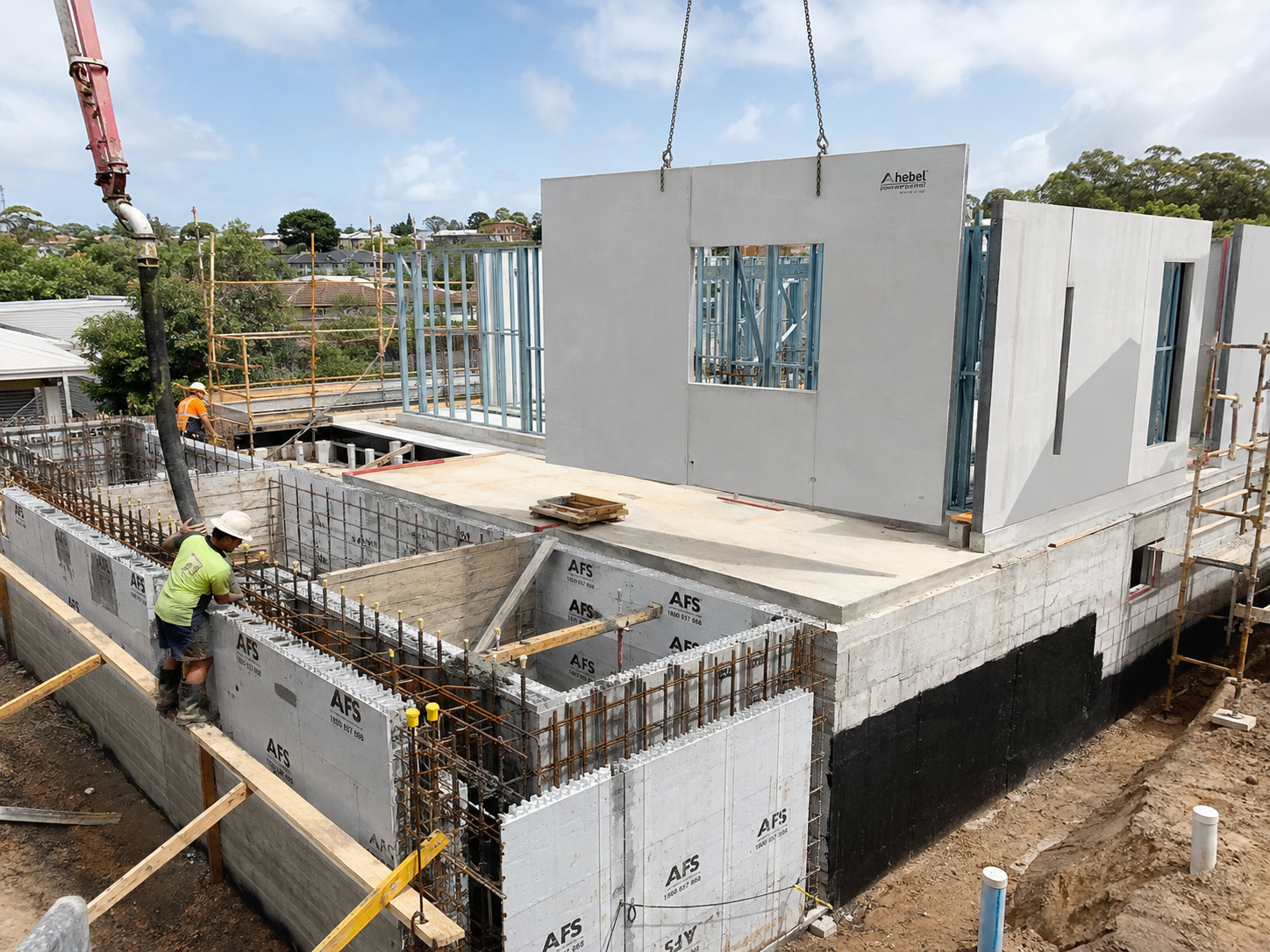
Hebel and AFS: Two Smarter Ways to Build
Construction is constantly balancing the same pressures: build faster, control labour costs, meet increasingly demanding performance requirements and still deliver a building that feels solid and is made to last.
That is where two CSR building systems—Hebel® Autoclaved Aerated Concrete (AAC) and AFS permanent formwork—have become increasingly familiar on Australian construction sites.
They are very different products, but they share a common goal: making complex wall construction simpler, faster and more efficient.
For builders, engineers, architects and contractors across Victoria, understanding where each system works best can make a significant difference to the way a project is designed and delivered.
So, What Exactly Is Hebel?
Hebel is a form of Autoclaved Aerated Concrete, or AAC. During manufacture, tiny air pockets are created throughout the concrete, producing a material that is considerably lighter than conventional concrete while retaining the strength needed for a wide range of construction applications.
CSR states that AAC is approximately one-fifth the weight of regular concrete. Hebel is manufactured as blocks and steel-reinforced panels and can be used for external and internal walls, party walls, floors, fire walls, shaft walls, facades, acoustic barriers and other applications.
That lightweight construction is one of Hebel's biggest advantages on site.
Instead of laying hundreds or thousands of individual bricks, large-format panels can cover a significant area in a relatively short period of time. CSR notes that installing one standard Hebel panel can replace the laying of approximately 75 standard bricks, while its PowerPanelXL system can be installed substantially faster than conventional brick construction.
But speed is only part of the story.
Why builders choose Hebel
Thermal performance
Those tiny air pockets inside AAC help provide excellent thermal insulation. Hebel wall systems can help reduce heat transfer through the building envelope, contributing to cooler interiors in summer and warmer interiors during winter.
For Victorian buildings, where temperatures can shift considerably between seasons—and sometimes during the same day—that thermal performance is particularly valuable.
Acoustic performance
The cellular structure of AAC also provides useful acoustic properties. Hebel systems are used extensively for apartment separation walls, corridors, external walls and other locations where controlling noise transmission matters.
Fire resistance
Hebel is a non-combustible building material. Depending on the particular Hebel system and wall configuration, CSR publishes Fire Resistance Levels ranging from 60 to 240 minutes.
That makes it particularly useful in applications such as party walls, fire walls, shaft walls and multi-residential construction.
A solid wall without conventional concrete weight
Hebel panels incorporate steel reinforcement while remaining much lighter than standard concrete. This combination gives builders a material that feels substantial once installed while being easier to handle during construction.
Then There Is AFS
Where Hebel provides lightweight AAC panels and blocks, AFS provides permanent formwork systems used to create reinforced concrete structural walls.
Instead of constructing temporary formwork, pouring the concrete and then stripping that formwork away, the AFS components remain as part of the completed wall.
AFS currently offers systems including Rediwall® and Logicwall®, each designed for different applications.
AFS Rediwall®
Rediwall is a permanent formwork system made from prefabricated interconnecting components that snap or slide together before being reinforced and concrete-filled.
It is commonly used for applications including:
- Basements
- Retaining walls
- Foundation walls
- Blade walls
- Columns
- Party walls
- Retention tanks
- Planter boxes
- Service and stormwater pits
Once concrete-filled and appropriately reinforced, the system creates a structural reinforced-concrete wall.
AFS states that Rediwall can reduce installation time by up to half compared with traditional masonry and blockwork methods. It is CodeMark Certified and designed for reinforced concrete walls in accordance with AS 3600.
For basement construction in particular, the appeal becomes obvious: form the wall, reinforce it, fill it and leave the formwork in place.
There is no conventional formwork stripping process afterwards.
AFS Logicwall®
Logicwall takes a slightly different approach.
It consists of lightweight prefabricated panels manufactured using fibre-cement sheets bonded to galvanised steel stud frames. The panels are erected on site and then core-filled with concrete to create the structural wall.
Because panels can arrive manufactured and labelled according to shop drawings, there can be considerably less measuring, cutting and traditional wall construction required on site.
Once installed and filled, the fibre-cement faces remain in place and provide a substrate that can receive finishes such as skim coating, acrylic render or paint.
AFS identifies benefits including faster construction, reduced on-site waste, reduced materials handling and fewer trades compared with some conventional wall construction methods.
Hebel or AFS? It Doesn't Always Have to Be One or the Other
This is where these products become particularly interesting.
Hebel and AFS are not necessarily competing solutions.
They can perform completely different jobs within the same building.
Imagine a multi-residential project.
AFS might be used to create reinforced concrete basement walls, retaining walls, lift cores or structural walls where significant structural capacity is required.
Move further up the building and Hebel may be used for external walling, party walls, corridors, fire-rated walls or other applications where a lightweight panel system with strong thermal, acoustic and fire performance is desirable.
CSR itself notes that AFS is regularly specified alongside other products within the CSR family, including Hebel.
It is less about finding one material that does everything and more about putting the right building system in the right part of the structure.
The Bigger Benefit: Construction Efficiency
The most interesting thing about both systems may actually be what they remove from the traditional construction process.
Hebel can reduce the amount of individual masonry units that need to be laid.
AFS permanent formwork can reduce conventional forming and stripping.
Logicwall panels can arrive manufactured to project requirements and labelled for installation.
Rediwall components interconnect to quickly create the permanent form before concrete placement.
That can translate into fewer individual construction steps, easier materials handling, reduced site waste and potentially faster progress through critical stages of the build.
And on a commercial construction project, every unnecessary handling process, additional trade and extra day on the programme can have a flow-on effect.
Performance Still Comes First
Speed is valuable, but construction systems still need to perform.
Both Hebel and AFS have extensive technical documentation covering structural design, fire resistance, acoustics, thermal performance, installation and compliance.
The important point is that these performances are system-specific.
A particular fire rating, acoustic rating or structural capacity should never simply be assumed because a project specifies "Hebel" or "AFS". Wall thickness, reinforcement, concrete specification, fixings, linings, junctions and the complete wall configuration can all affect performance.
Product selection should therefore always be made using the current manufacturer documentation together with the project's architectural and engineering requirements.
Building Smarter, Not Just Faster
There is a reason products such as Hebel and AFS continue to appear on residential, multi-residential and commercial projects.
They address some very practical construction problems.
Hebel gives builders a lightweight concrete solution with strong thermal, acoustic and fire-performance characteristics.
AFS provides permanent formwork systems capable of turning prefabricated components into solid reinforced-concrete structural walls.
Used in the right application, both can simplify construction without asking the project to compromise on performance.
For Victorian builders facing tighter programmes, more complex designs and increasing demands on building performance, that combination of speed, efficiency and engineered performance is becoming increasingly difficult to ignore.
If you're considering CSR Hebel or AFS for an upcoming Victorian project, speak with ATC about product requirements, sizes and availability.